Help children practice writing common Simplified Chinese characters with printable tracing rows, model characters, and space for independent attempts.
Chinese character tracing worksheets for kids give beginning learners a place to look closely at a character and practice its shape with a pencil. They are most useful when children have already had a chance to see or hear the word and are ready for a short handwriting activity.
Tracing and flashcards are related but serve different purposes. A flashcard is mainly for recognition and recall; a tracing worksheet guides a child from looking at a model to trying the character independently. A tracing row is not the same as a full stroke-order lesson, so parents should not treat it as a substitute for an accurate demonstration of how to write a character.
What makes a useful Chinese tracing worksheet?
- A clear model character that is large enough to see.
- Light tracing boxes or faded models for guided practice.
- Blank writing boxes for the child’s own attempt.
- Enough space to write without crowding the next character.
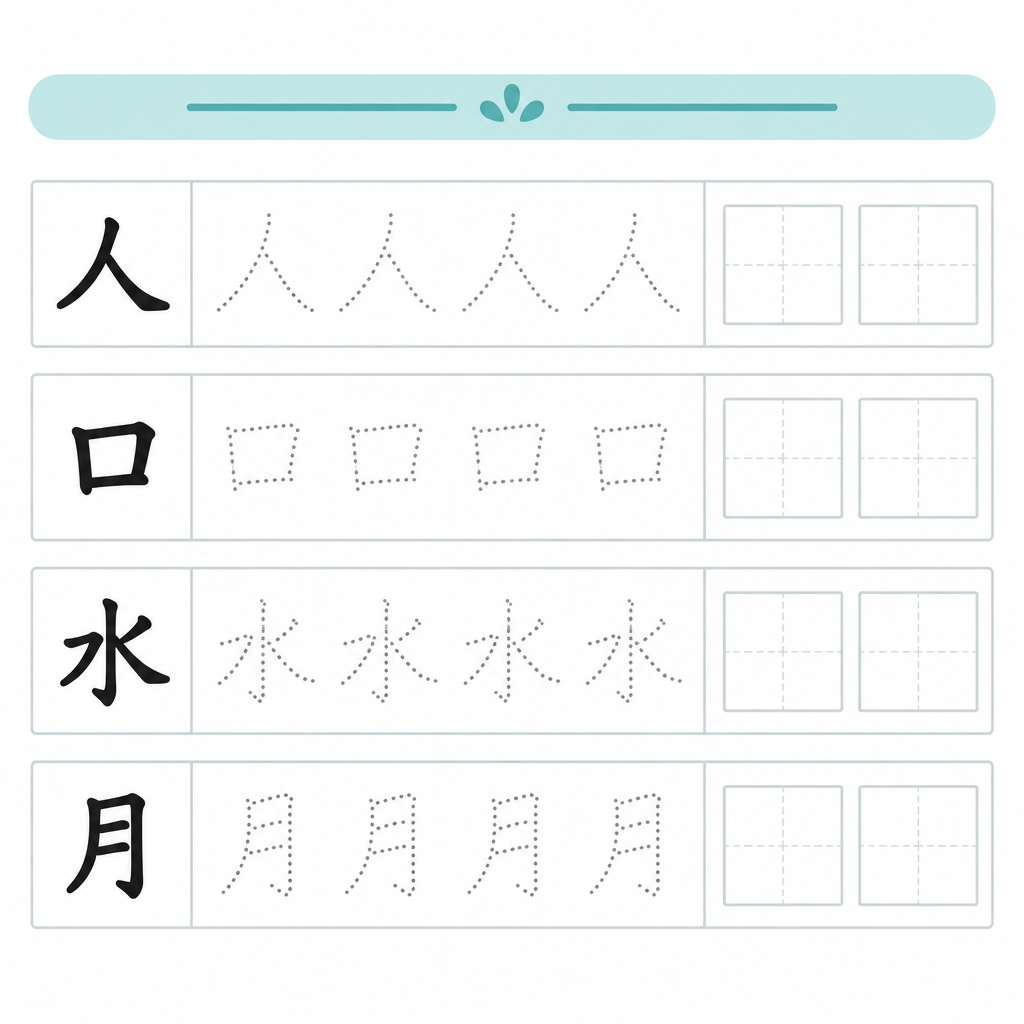
For a beginner, familiar and visually distinct characters can be a reasonable starting point. The prepared worksheet set includes common characters such as 人, 口, 水, and 月. Pair each character with its pinyin and a simple meaning during the first introduction, but keep the writing session itself short.
How to use character tracing worksheets
1. Look at the model first
Point out the overall character shape before asking the child to write. Say the pronunciation and meaning if the child is learning the word for the first time.
2. Trace slowly
Invite the child to follow the light model with a pencil. If they have difficulty controlling the pencil, reduce the number of repetitions instead of pushing through a whole row.
3. Try one independently
After tracing, let the child use a blank box to try the character. Compare the attempt with the model in a neutral way: notice what looks similar and identify one feature to practice next.
4. Stop before fatigue
Writing Chinese characters takes visual attention and controlled movement. A few careful attempts may be more useful than filling every box while tired.
Free printable Chinese character tracing sample PDF
Download the free Chinese character tracing worksheet sample (PDF) with model characters for 人, 口, 水, and 月, guided tracing spaces, and blank writing boxes.
Preview the tracing worksheets
The image below illustrates the worksheet layout with model characters, guided tracing, and blank practice boxes.
Tracing practice versus stroke order
Tracing helps a learner practice the appearance and movement of writing a character, but correct stroke order should be demonstrated with a reliable model or teacher guidance. If a child is learning a new character, show the correct sequence first, then use the worksheet to reinforce the shape. Avoid inventing stroke steps from a low-resolution image.
Printing and pencil tips
Check the PDF print preview before printing. Choose “Fit to printable area” when adapting a US Letter page to A4 paper. A regular pencil and a stable writing surface are sufficient. If a child is not ready for pencil practice, they can first trace the character in the air or follow it with a finger.
Frequently asked questions
What age is right for Chinese tracing worksheets?
Readiness varies. Look for a child’s interest in drawing lines or shapes and their ability to engage briefly with a guided task rather than relying on age alone.
Do tracing worksheets teach Chinese characters by themselves?
No. They support handwriting practice. Children also need to connect written forms with pronunciation, meaning, and words in context.
Should I ask my child to fill every box?
Not necessarily. A few careful attempts with good form and attention are preferable to repetitive writing after the child becomes tired.