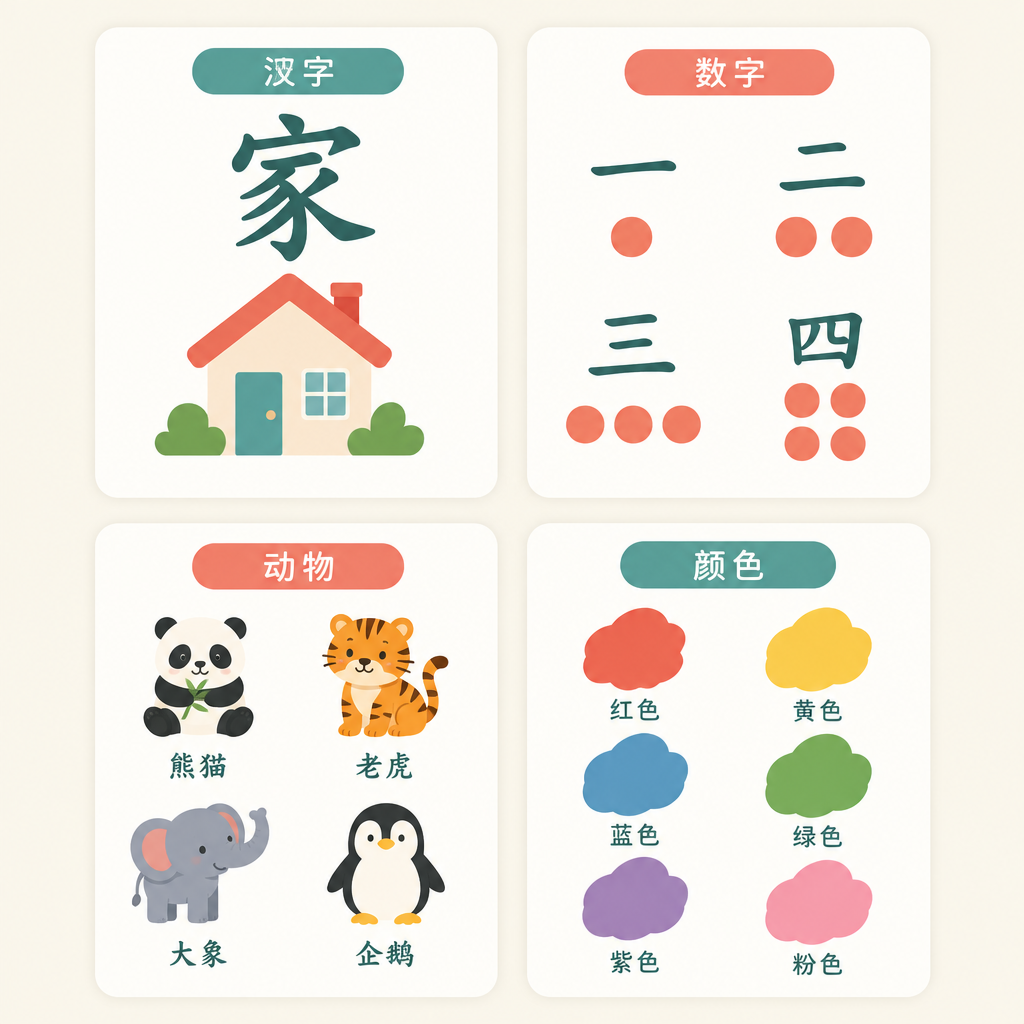
A practical guide to using Chinese flashcards with tone-marked pinyin and English meanings for beginner children and families learning Mandarin at home.
Chinese flashcards with pinyin and English meanings can make early Mandarin practice easier for families who do not speak Chinese fluently. The character shows the written form, pinyin gives a pronunciation guide, and the English meaning helps parents understand what the card represents.
These elements support one another, but they are not interchangeable. Pinyin is not an English spelling system, and a single English word may not capture every meaning a Chinese character can have in different contexts. Use the card as a starting point for hearing and using the word—not as a complete lesson by itself.
What should a good Chinese flashcard include?
- Simplified Chinese: the character or word the learner is practicing.
- Tone-marked pinyin: a cue such as rén, kǒu, shǒu, or shuǐ.
- An English gloss: a short meaning to help a parent guide the activity.
- A clear visual cue: a picture or familiar object when it adds meaning.
For example, 人 (rén) means “person,” 手 (shǒu) means “hand,” 水 (shuǐ) means “water,” and 学 (xué) relates to “study” or “learn.” Some characters have several meanings or appear in many compounds, so it is often more useful to practice them in a word or short phrase as the learner progresses.
How to use pinyin flashcards at home
1. Say the sound before asking for recall
Point to the character and say the pinyin out loud. Keep your model calm and clear. Mandarin tones affect meaning, so tone marks should be visible, but young beginners can start by listening and repeating rather than memorizing every rule at once.
2. Connect the card to a real object
For 手 (shǒu), point to a hand; for 水 (shuǐ), show a glass of water. Concrete examples give a child more than an English translation alone.
3. Fade the prompts gradually
At first, show character, pinyin, and meaning together. Later cover the English gloss and ask what the card means. When that becomes familiar, cover the pinyin and model the pronunciation only if needed.
4. Introduce words, not only isolated characters
Chinese characters frequently appear in multi-character words. A card for 学 (xué) can be paired with 学校 (xuéxiào, school) or 学习 (xuéxí, study/learn) when the child is ready. Explain each example in context instead of assuming every character maps to one English word.
Free printable sample PDF
Download the free Chinese flashcards sample PDF for a beginner-friendly introduction to Chinese characters, tone-number pinyin, and English meanings.
Preview the cards
Here are four sample cards from the printable sampler. Each card pairs a simplified Chinese character with tone-marked pinyin and an English meaning.


Common mistakes to avoid
- Do not treat pinyin as a replacement for seeing Chinese characters.
- Do not insist that a child memorize a large stack in one session.
- Do not assume that an English gloss explains every use of a character.
- Do not overcorrect pronunciation during every turn; provide a good model and return to the sound naturally.
Frequently asked questions
Does every Chinese character have one pinyin spelling?
Many characters have a common pronunciation, but some characters have more than one pronunciation depending on use. Verify the pronunciation for the specific word shown on a card.
Are pinyin flashcards enough to learn Chinese?
No. They are a useful aid for early recognition and review. Listening, speaking, reading in context, and writing practice all contribute to a broader learning routine.
Should English meanings stay on the cards?
They are helpful for parents and beginners. As familiarity grows, you can cover the English gloss during recall activities without removing it from the resource itself.