Explore beginner Chinese flashcards for kids across basic characters, numbers, animals, and colors, with pinyin, English meanings, and simple home activities.
Looking for printable Chinese flashcards that your child can use at home, in a homeschool routine, or alongside a beginner Mandarin class? This guide brings together beginner-friendly card sets designed to connect Simplified Chinese characters with pinyin and English meanings.
Flashcards work best as short, repeatable activities. You do not need to introduce a large stack at once. Start with a few familiar words, say each one aloud, and revisit them over several days. The goal is to help a child notice the written form and connect it with meaning—not to rush through a list.
Choose a Chinese flashcard set
Basic Chinese character flashcards
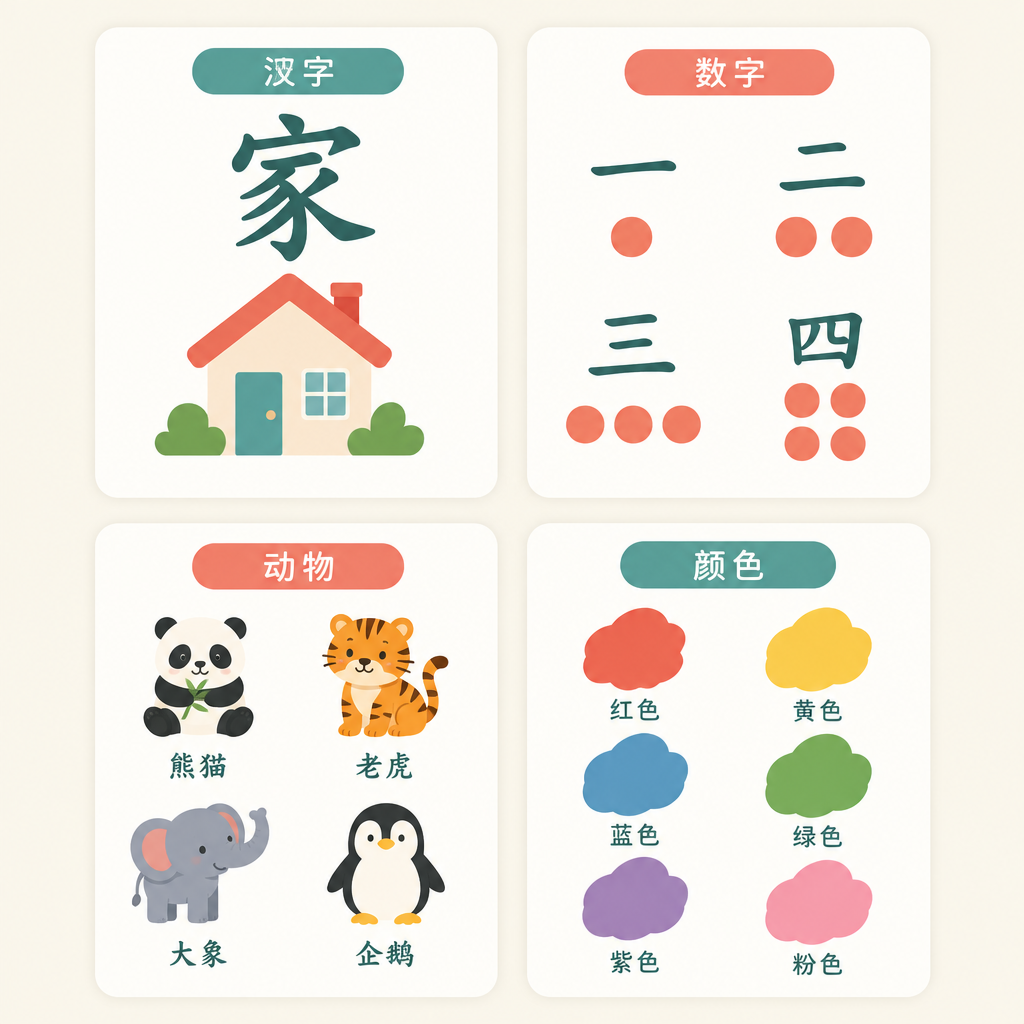
Begin with familiar characters such as 人 (rén, person), 口 (kǒu, mouth), 手 (shǒu, hand), 山 (shān, mountain), 水 (shuǐ, water), 日 (rì, sun/day), 月 (yuè, moon/month), 学 (xué, study), and 家 (jiā, home/family). A simple English gloss can help a parent guide practice, while the pinyin provides a pronunciation cue.
Chinese number flashcards
Number cards are useful for quick counting games. Match a Chinese numeral to a group of toys, count steps together, or ask your child to find one, two, or three objects around the room. The visual count is a prompt for talking and counting, not a substitute for understanding quantity.
Chinese animal flashcards
Animals can make first-word practice more engaging. For example, 猫 (māo) means cat, 狗 (gǒu) means dog, 鸟 (niǎo) means bird, and 鱼 (yú) means fish. Children can match a card to a toy, a picture book, or an animal they already know.
Chinese color flashcards
Color cards connect a word to objects in a child’s environment. Examples include 红色 (hóng sè, red), 蓝色 (lán sè, blue), 黄色 (huáng sè, yellow), and 绿色 (lǜ sè, green). After looking at a card, invite your child to find something of that color.
Chinese character tracing worksheets
When a child is ready to practice writing, use tracing sheets as a separate activity. Recognition cards and writing worksheets serve different purposes: a flashcard helps the learner identify a character or word, while a worksheet offers space to follow a model and try writing independently.
Free printable sample PDF
Download the free one-page Chinese flashcards sample PDF for a print-ready introduction to basic characters, numbers, animals, and colors. This one-page sample uses pinyin tone numbers.
Explore the focused guides: flashcards with pinyin and English meanings, number flashcards, animal flashcards, color flashcards, and character tracing worksheets.
Preview the flashcards
Preview the main themes in this printable collection below. This is an illustrative overview; use the sample PDF link below to print the starter cards.
How to use Chinese flashcards with kids
- Keep it short. Start with three to five cards and finish before the activity becomes tiring.
- Say, look, and connect. Point to the character, model the pronunciation, and explain the meaning in a simple sentence.
- Mix recognition and recall. First show the pinyin and meaning; later cover one of them and invite your child to remember.
- Use everyday moments. Count toys with number cards, find colors around the house, or look for animals in a story.
- Repeat without pressure. Revisit familiar cards across the week instead of testing every card in one sitting.
Printing tips
When the PDFs are available, open them in a PDF reader and check the print preview before printing. Choose “Fit to printable area” if you use A4 paper with a US Letter layout. Cardstock can make cards sturdier, but ordinary paper is enough for a first try. Keep printed cards in a small envelope or ring them together so the set is easy to reuse.
These materials are intended for personal or classroom learning. Do not resell the PDFs as standalone products or redistribute them as your own work.
Frequently asked questions
Are Chinese flashcards suitable for complete beginners?
Yes. A parent or teacher can model the sound and explain the meaning. Children do not need to read pinyin independently to look at cards together.
Should children learn pinyin before using flashcards?
No formal prerequisite is required for shared practice. Pinyin is a pronunciation aid; an adult can say the word aloud and let the child become familiar with the sound gradually.
Which set should we start with?
Choose the theme your child already knows best. Numbers support counting, animals invite matching games, colors encourage looking around the room, and basic characters provide a broader introduction.