A realistic guide for non-native parents teaching pinyin at home — using video, audio and printable worksheets so you facilitate instead of lecturing.
How to Teach Pinyin at Home (Even If You Don't Speak Mandarin Fluently)
You do not need to be the pronunciation expert. You need to press play, point, and keep the mood light. Here is the facilitator's version.
The biggest myth about teaching pinyin is that the parent must already speak Mandarin. You don't. Pinyin is a written sound system — and a recording can be the voice while you are the coach. Your job is to set up the activity, hit play, point to the right spot, and notice what your child can already do.
This guide maps each parent job to a tool in our printable collection, and gives three activities you can run without fluent Chinese.
1 video course (《拼音王国游历记》), song audio sheets, and 33 printable PDFs — all visual or audio-led, so you facilitate instead of lecture.
Your Job Is to Facilitate, Not to Be Fluent
| What you do | What the material does | Tool in this collection |
|---|---|---|
| Press play & model listening | Provides the correct sound | Video course folder, song audio sheets |
| Point to the written form | Shows the letter or tone mark | Single-final & tracing PDFs |
| Set a tiny task | Gives a clear, bounded activity | Any one worksheet page |
| Check without judging | Confirms the answer | Answer keys in review PDFs |
Notice what is not on the list: producing perfect tones yourself. Outsource that to the audio.
Before You Begin: Let the Audio Be the Teacher
Pinyin letters look like English but often sound different. If you guess from English spelling, you may teach the wrong habit. So for every sound, use a reliable recording. Two free, university-led options model tones and finals accurately: the Open University's beginner Chinese audio (open.edu — single finals) and the University of Texas at Austin's Pitch Perfect Pinyin (laits.utexas.edu/ppp).
And remember: pinyin records sound; Chinese characters carry meaning. Keep these as separate goals so a shaky tone never feels like a reading failure.
Use the Video Course as the Teacher
The collection includes a full video course, 《拼音王国游历记》("Adventures in the Pinyin Kingdom"). Let it introduce a sound while you simply watch with your child. After the clip, you only need to replay a moment and point to the matching letter on a worksheet.
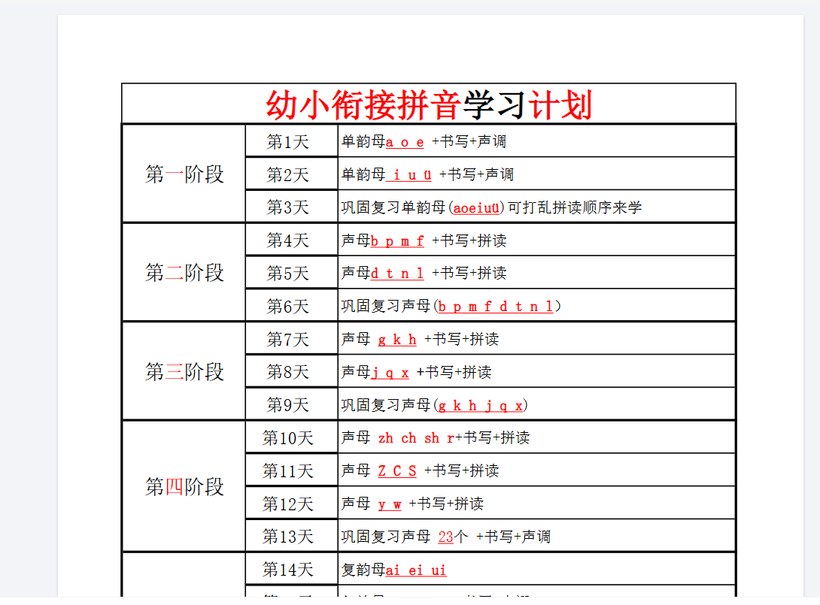
Try a Watch-Then-Point activity
Watch one short clip together. Pause, then point to the letter the video just taught on a printed page. You are not teaching the sound — you are connecting the video's sound to the printed symbol.
Lean on Audio for Pronunciation
When a worksheet asks for a sound you are unsure of, play the song sheet or an audio model and let your child echo it. You can say "listen and copy the recording" — that is a complete instruction from a non-native parent.
Try a Two-Choice listening game
Write mā and mà on paper. Play one. Ask your child to point to what they heard. You don't need to know which is which yourself — the recording decides, and you just check the answer together afterward.
Tracing & Writing — You Are the Scribe
For writing pages, your role is to hold the page, name the letter, and cheer. If your child is not ready for a pencil, trace the shape with a finger. You are managing the task, not grading the accent.
Blending With Cards
Write an initial on one card and a final on another (m + a). Play the combined sound from audio, then point to the spelled form on the worksheet. Building the syllable physically makes blending concrete — no fluent speech required.
Three Activities You Can Run Without Fluent Chinese
These are original activity ideas for this guide, not reproductions of the collection. Answers at the end.
Activity 1 — Point to the sound
Play a recording of a. Child points to a among a o e. You confirm by replaying.
a o e
Activity 2 — Two-choice tone
Play mǎ or mā. Child points to the matching syllable below.
mā mǎ
Activity 3 — Build a syllable
Place h and ao cards together. Play hǎo. Child points to the combined spelling.
All three are check-by-audio: the recording is the answer key, so you facilitate without needing to judge tones yourself.
A 10-Minute Facilitator Routine
| Minutes | Parent action |
|---|---|
| 0–3 | Press play on one clip or song; watch/listen together. |
| 3–6 | Set one tiny task from a worksheet (point, match, or trace a few). |
| 6–9 | Play a game (cards, two-choice listening) using the audio as judge. |
| 9–10 | Note one sound to revisit. Done. |
Frequently Asked Questions
What if I mispronounce a sound?
Let the audio lead every sound, and you will rarely need to produce one. When you do, say "let's check with the recording" — modeling that habit is more valuable than being right.
I don't speak any Chinese at all. Is this still usable?
Yes. The video course and song sheets carry the language; your job is setup, pointing, and encouragement. Many heritage families use exactly this division of labor.
I'm short on time. How little is enough?
Ten minutes, a few times a week, beats a rushed hourly cram. Consistency with audio models matters more than your own fluency.
My child is older. Is pinyin still relevant?
Yes — pinyin helps an older beginner decode pronunciation and use dictionaries or input methods. The same collection works; just pick the more advanced blending and review PDFs.
When do we add characters?
Whenever the child shows interest. Keep pinyin as the sound label and introduce characters separately so the two skills don't collide.
Start by Facilitating One Clip
Open one short video or song, watch it once, point to one letter on a printed page. You just taught a lesson without saying a word of Mandarin. Build from there.
Free share folder. Open in the Quark app or web. Overseas access note below.
• Pinyin Worksheets for Kids — printable tracing, tone and blending sheets
• Pinyin Songs for Kids — rhymes and chants that teach tones
• Chinese Pinyin Chart for Kids — printable initials, finals and tones
• Chinese Pinyin for Kids: Parent’s Guide — start here for the full path
Parent-to-parent guide, not a licensed curriculum. Pinyin is a pronunciation aid, not a replacement for character learning. Preview and print only materials you are authorized to use. External audio links are free reference resources and are not affiliated with this site.
Disclaimer: The resources mentioned on this page are collected from public channels for personal learning and sharing. All copyrights belong to their original authors or publishers. Please do not use them for commercial purposes, and delete the files within 24 hours of downloading. If any content appears to infringe a copyright, contact us and we will remove it promptly. Whenever possible, please support the original creators by purchasing official versions.