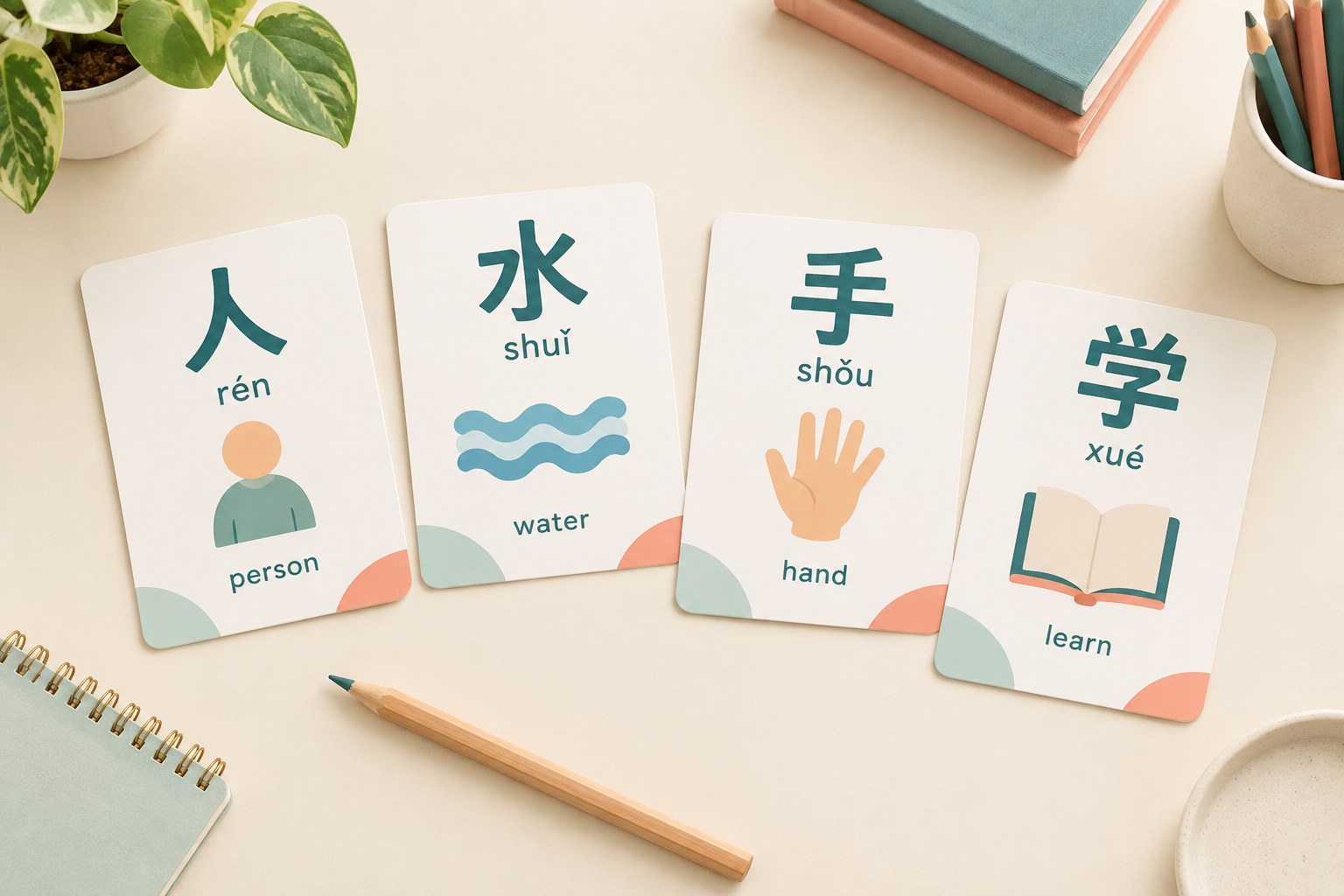
A parent’s guide to pinyin worksheets for kids — tracing, tone practice and syllable blending — with simple at-home activities using printable Mandarin materials.
Pinyin Worksheets for Kids: Printable Tracing, Tone & Blending Practice
A parent-to-parent guide to using printable pinyin materials at home — without printing an entire workbook or teaching the whole chart in one sitting.
Looking for pinyin worksheets for kids but not sure which pages to start with? You are not alone. Most parents who message me have a folder of PDFs they downloaded in a panic and then never opened, because the pile looks like a curriculum and they are not a teacher.
The fix is small: pick one task — recognizing a sound, spotting a tone mark, tracing a letter, or blending a syllable. You do not need the full chart, and you do not need to finish a page. Below is a map of the common worksheet types, three short activities you can try today, and a ten-minute routine that fits real family life.
One share folder: 1 video course + 33 printable PDFs (single-finals, tracing, blending, tone, checkpoints). See the access note near the end if you are outside mainland China.
Choose a Pinyin Worksheet by Skill
Before printing, decide what you want your child to practice. Use this table to find a starting point, not as a checklist where every row is the next compulsory step.
| What you want to practice | Worksheet type | A simple first task | In this collection |
|---|---|---|---|
| Recognizing basic vowel sounds | Single-final worksheets | Listen to a sound, point to its written form | 单韵母.pdf, 拼音单韵母+声母练习.pdf |
| Identifying & producing tones | Four-tone practice pages | Match a recorded syllable to its tone mark | 拼音77首.pdf, 一年级上册拼音儿歌汇总.pdf |
| Forming pinyin letters | Tracing worksheets | Trace a few examples, then copy one | 拼音描红本正文.pdf, 幼小衔接拼音描红字帖.pdf |
| Combining sounds into syllables | Initial + final blending | Blend a familiar initial and final | 拼音复韵母+鼻韵母+整体认读.pdf, 我要做拼音拼读小能手.pdf |
| Reading complex endings | Compound & nasal-final pages | Practice one small group (e.g. an / ang) | 复韵母.pdf, 前鼻韵母.pdf, 后鼻韵母.pdf |
| Reviewing familiar sounds | Mixed / checkpoint pages | Complete a short review of sounds already learned | 幼小衔接拼音知识汇总.pdf, 分类过关检测.pdf |
| Keeping it playful | Games & maze pages | One maze or matching game | 拼音真好玩儿迷宫版.pdf |
For a first session, choose just one row. A listening activity does not have to become a handwriting lesson, and a tracing page does not have to become a spelling test.
Before You Begin: Pinyin Letters Represent Mandarin Sounds
Pinyin uses the Roman alphabet to write Mandarin pronunciation. It is a pronunciation system, not a replacement for Chinese characters. Different characters can share the same pinyin spelling and tone, so sounding out pinyin is not the same as recognizing a character or understanding a word.
The letters may look familiar, but their sounds do not always match English. For example, pinyin b and p are distinguished more by aspiration than by the voiced/voiceless split English speakers expect. The Open University's free beginner Chinese course introduces the six single finals with recorded audio so you can hear the target, not guess from spelling (open.edu — Pronunciation: single finals). The University of Texas at Austin's Pitch Perfect Pinyin is another free, interactive way to check tones and finals (laits.utexas.edu/ppp).
For any activity below, follow this order:
Listen → Point → Repeat → Read or Write
You do not need every step each time. For a child not ready to write, stop after point and repeat.
Single-Final Pinyin Worksheets
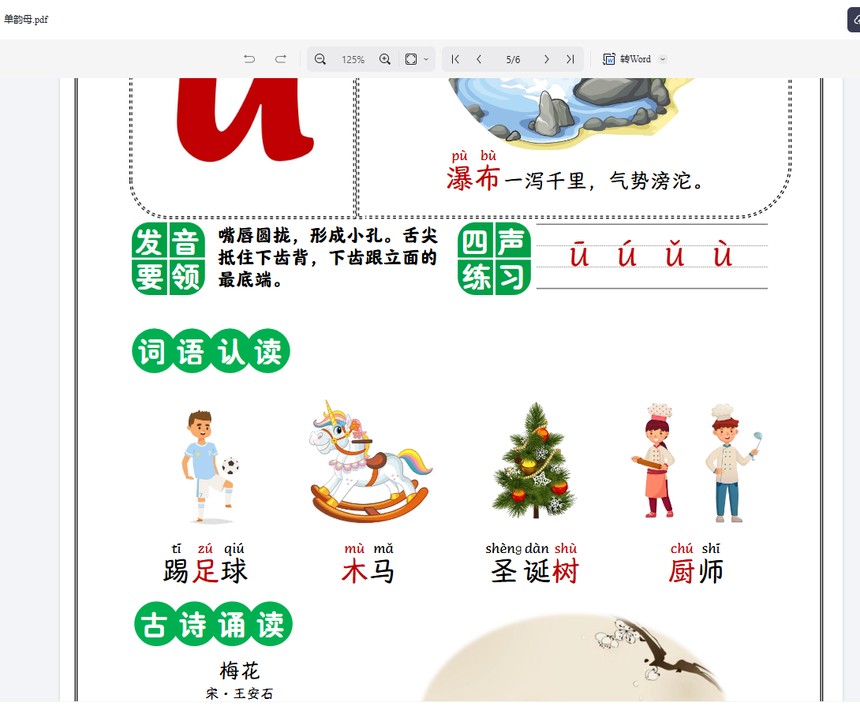
Single-final worksheets introduce the six basic vowel forms taught in Chinese as 单韵母 (dān yùnmǔ):
a · o · e · i · u · ü
These are the best starting group for connecting written pinyin to sound. The Open University presents exactly these six with recorded practice.
Try a Listen-and-Point activity
Start with two or three forms on the page, such as a, o, e. Play one sound from your lesson audio, ask your child to point to the matching letter, then listen again and repeat together. Change the order before another round. Put the pencil aside — the task is to connect something heard with something seen.
When choosing single-final pages, look for clear letters and enough space to point, circle, or mark without crowding the page.
Pinyin Tone Practice Worksheets
A tone worksheet should involve listening, not only drawing marks. Mandarin has four basic tones and a neutral tone. For isolated practice, introduce the four patterns on the same syllable:
| Tone | Example | Shape |
|---|---|---|
| First (high level) | mā | High and even |
| Second (rising) | má | Goes up |
| Third (dipping) | mǎ | Low dip in isolated pronunciation |
| Fourth (falling) | mà | Sharp drop |
In connected speech the third tone often does not show the full dip pictured in beginner diagrams — follow the recording rather than asking your child to exaggerate it every time.
Try a Two-Choice listening game
Write mā and mà on paper. Play one and ask your child to point to what they hear. Swap turns. Keep the choice small before adding options. A hand gesture helps: move horizontally for level, downward for falling — as a reminder to accompany the sound, not a substitute for hearing it.
Distinguish the two tasks: recognizing a written tone mark and recognizing a spoken tone are different skills. Both can be practiced; success at one does not prove the other.
Pinyin Tracing Worksheets
Use tracing pages when you want to focus on letter formation. Pick a page with a clear model, a small number of traceable examples, and space for independent copying.
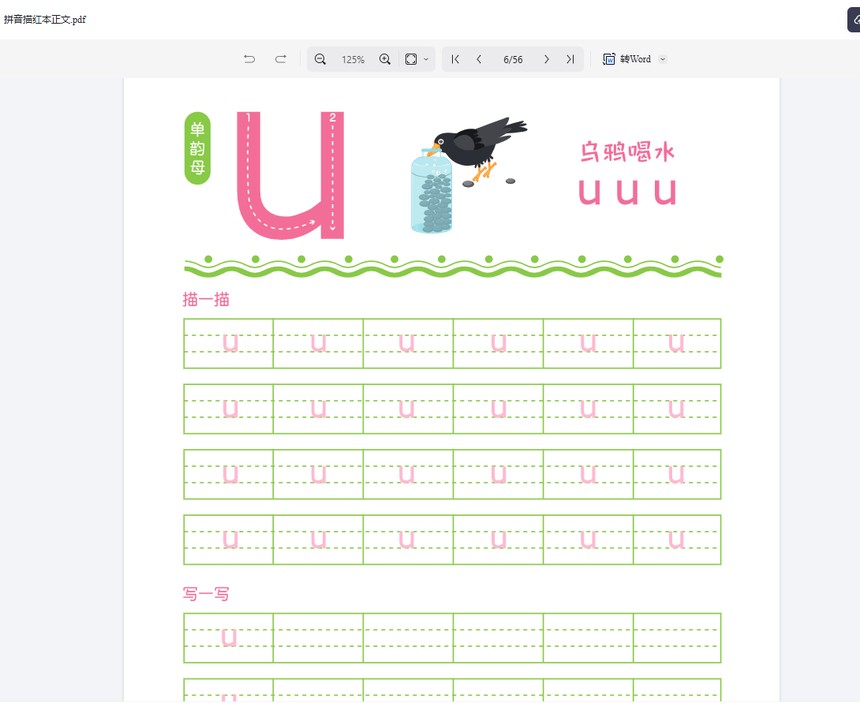
Try a short sequence with u
Look at the model → trace three examples → copy one → listen and repeat. Keep the writing limited; cover the remaining rows with another sheet and return later. For a child not ready for pencil work, adapt: point to the letter, trace its shape with a finger, or find the same letter elsewhere on the page.
Check what the page actually teaches. Pinyin tracing practices alphabetic forms; Chinese-character tracing practices characters. They are different resources, even inside the same beginner workbook.
Initial-and-Final Blending Worksheets
Blending pages combine parts of a syllable. An initial is the opening consonant; a final is the following vowel or vowel group, sometimes ending in n or ng. Some syllables have a final with no initial.
m + a → ma | h + ao → hao
Try a Build-and-Read activity
Write m on one card and a on another. Place them side by side, play the full syllable, repeat together, then point to the combined spelling on the worksheet. Work with a few combinations from the lesson your child already follows — do not assume every initial pairs with every final. Keep the tone in the practice rather than treating it as an afterthought.
Compound-Final and Nasal-Final Practice
After some familiar single finals and syllables, choose a small group of extra endings — compound finals like ai, ao, ou and nasal finals like an, en, ang, eng. Try one contrast at a time (e.g. en vs eng), listen to its examples, and use a worksheet to identify the endings. Avoid racing through every combination; mark two to revisit and leave the rest.
Three Mini Pinyin Exercises to Try Now
These are original practice examples written for this guide, not reproductions of pages from the collection. Answers are at the end.
Exercise 1 — Find the matching letter
Parent: point to the model ü, then ask your child to circle the identical form below.
u ü o i
This is a visual task. Add pronunciation separately with your lesson audio.
Exercise 2 — Find the fourth-tone mark
Circle the syllable with the fourth-tone mark.
mā má mǎ mà
To make it a listening task, play a recording and ask your child to choose what they hear.
Exercise 3 — Complete the written combination
Choose the missing final: m + ____ → ma
a / o
After completing it, listen to and repeat a toned example from your lesson.
Answers — Exercise 1: ü. Exercise 2: mà. Exercise 3: a.
A Simple At-Home Practice Routine
A suggested ten-minute session. Treat the timing as a flexible example, not a daily requirement or a promise of progress.
| Minutes | What to do |
|---|---|
| 0–2 | Listen together: replay a few sounds from your lesson, point to their written forms. |
| 2–5 | One worksheet task: a short match, a few traces, or a small set of blending questions. Stop at the task you chose, even if the page has more. |
| 5–8 | Play with the same material: rearrange letter cards, point to a sound your child hears, or find a matching syllable. |
| 8–10 | Review: return to one example done comfortably and one to revisit next time. Note what you practiced so you can pick the next page deliberately. |
For a shorter session, use only the listening activity and one worksheet task.
Frequently Asked Questions
Which pinyin worksheets should a complete beginner start with?
Start with a narrowly focused activity: recognizing a few single finals, matching a sound to a letter, or identifying two tone marks. A page full of mixed syllables is useful later as review, but it does not need to be your first print.
Can I help if I don't speak Mandarin fluently?
Yes. You can organize the activity, read instructions, point to examples, and help with tracing. For pronunciation, use a reliable audio model instead of reading pinyin through English — the Open University and UT Austin links above are free and parent-friendly. When unsure about a sound, replay it or ask a teacher rather than correcting from a guess.
Should my child finish pinyin before learning characters?
Not necessarily. Use pinyin alongside familiar spoken words and age-appropriate character activities, or follow your child's school order. Keep the goals distinct: pinyin records sound; character learning also involves recognizing written forms and connecting them with meaning.
Are these activities only for children who can write?
No. The listen-and-point and visual-matching activities need no pencil. For writing pages, choose a manageable amount or adapt to finger tracing. Choose by the skill you want to practice, not by expecting every child to finish every page identically.
How should I print pinyin worksheet PDFs?
After obtaining an authorized PDF, preview it and print one test page before the full file. Check that letters, tone marks, and writing lines are clear and nothing is cut off. Print only the pages you plan to use next.
Start With One Worksheet
Choose a page for one purpose: listening, tone recognition, tracing, or blending. Keep a pronunciation model nearby, complete a small task together, and note what to revisit. The rest of the collection can wait until you need it.
Free share folder. Open in the Quark cloud app or web. If you are outside mainland China and the link is awkward, see the note below.
• Pinyin Songs for Kids — rhymes and chants that teach tones
• Teach Pinyin at Home (Non-Native Parent) — audio models and a 10-minute routine
• Chinese Pinyin Chart for Kids — printable initials, finals and tones
• Chinese Pinyin for Kids: Parent’s Guide — start here for the full path
This page is a parent-to-parent guide, not a licensed curriculum. Pinyin is a pronunciation aid for Mandarin; it does not replace character learning. Always preview and print materials you are authorized to use. External links to Open University and UT Austin are provided for free pronunciation reference and are not affiliated with this site.
Disclaimer: The resources mentioned on this page are collected from public channels for personal learning and sharing. All copyrights belong to their original authors or publishers. Please do not use them for commercial purposes, and delete the files within 24 hours of downloading. If any content appears to infringe a copyright, contact us and we will remove it promptly. Whenever possible, please support the original creators by purchasing official versions.