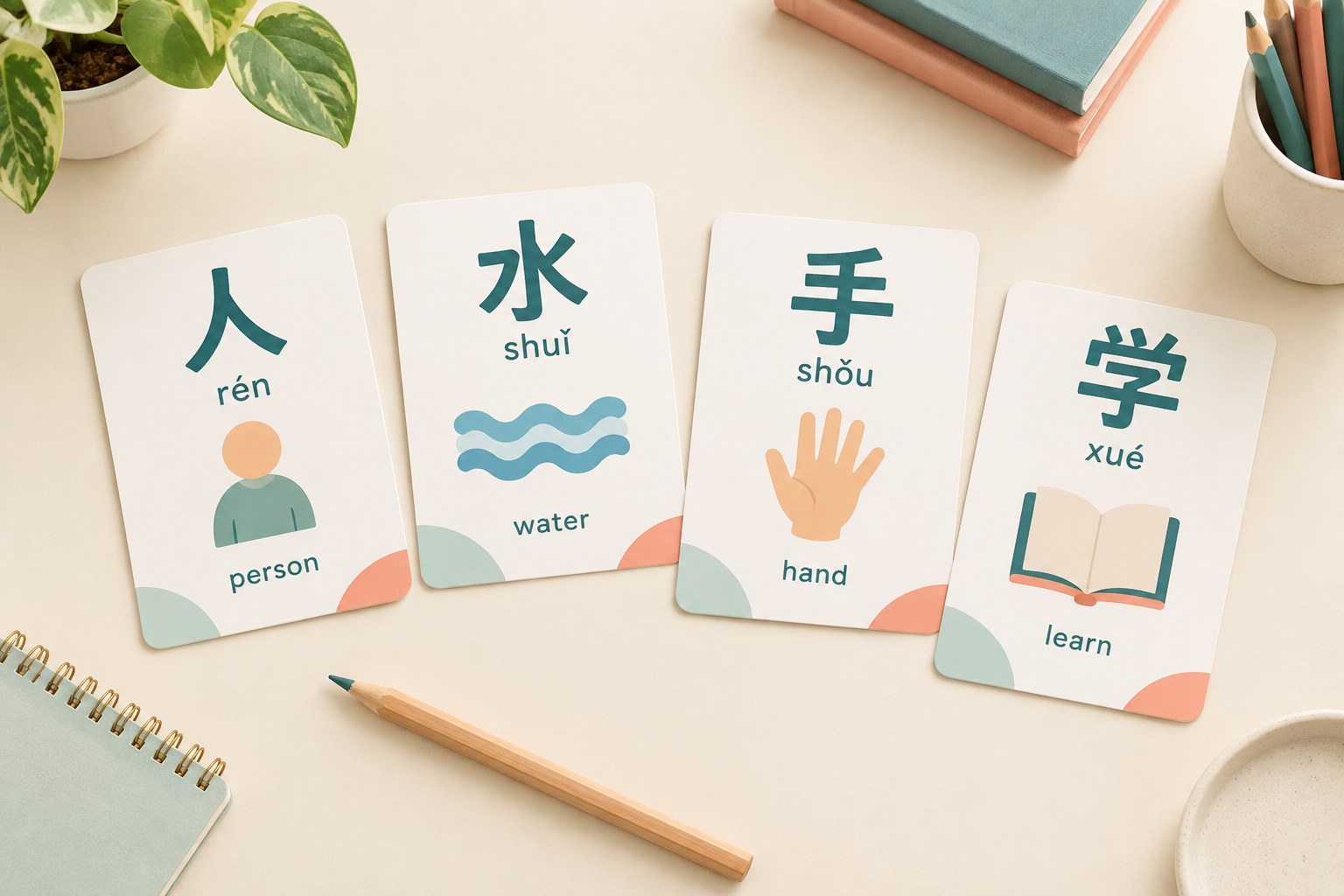
A parent-to-parent guide to teaching Chinese pinyin to kids at home: what pinyin is, why it matters, and how to use videos, songs and printable worksheets step by step.
Chinese Pinyin for Kids: A Parent's Guide to the Foundations of Chinese Literacy
Last updated: October 2026 · For parents raising bilingual or heritage-language children, ages 3–7
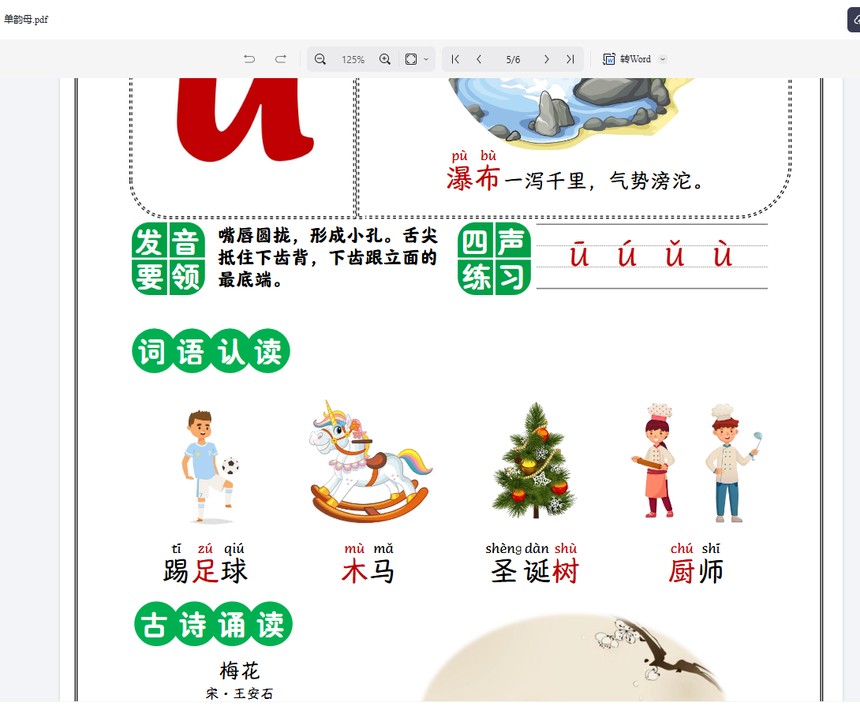
When you decide you want your child to read Chinese, the first question is almost always the same: “Where do I even start?” You know characters are the goal, but characters look like a wall of mystery. The honest answer most Chinese teachers will give you is: start with pinyin — the phonetic alphabet that Chinese children themselves learn before they ever read a book.
This guide explains what pinyin actually is, why it is the on-ramp to Chinese literacy (not a shortcut around it), and how to use a complete, ready-made starter kit — a video course plus dozens of printable worksheets — to teach it at home, even if you are not a trained teacher.
What is pinyin, in plain terms?
Pinyin is a system that spells Chinese sounds using the Roman alphabet. Every Chinese character has a pronunciation, and pinyin writes that pronunciation down with letters you already recognize — b, p, m, a, o, i — plus small marks called tones that tell you which pitch to use.
Here is the part that surprises many parents new to Chinese: pinyin is not the language. It is a pronunciation aid. Native Chinese kids learn pinyin in the first months of school precisely so they can sound out characters, look them up in a dictionary, and type them on a phone or computer. Once a child can read, pinyin quietly steps back. So think of pinyin as training wheels — essential at the start, gradually left behind.
For a child growing up outside China, pinyin does double duty. It gives them a reliable way to hear and say Chinese correctly from day one, and it lets a non-fluent parent still guide practice, because the spelling is transparent. You do not need to read characters yourself to help your child drill “b–a → ba.”
Is pinyin necessary, or can my child just learn characters?
This is the question every heritage-language parent asks, and the answer matters for how you spend your time.
- If your child attends a Chinese-language school (weekend heritage school, immersion program), they will use pinyin from week one. Skipping it means your child is behind on day one.
- If you are teaching at home casually, pinyin still earns its place: it makes pronunciation consistent instead of guessed, and it unlocks every pinyin-labeled book, app, and dictionary on the market.
- The only case to delay pinyin is very young toddlers (under ~3) where you focus purely on listening and speaking. Even then, introducing the alphabet-style chart visually does no harm.
Bottom line: for any child who will eventually read and write Chinese, pinyin is the most efficient first step. It is the difference between memorizing thousands of shapes by rote and having a system to decode them.
The complete pinyin starter kit: what a full set looks like
A good pinyin program is not one workbook — it is a sequence. Below is the structure of a comprehensive starter kit we reviewed, organized exactly the way Chinese educators layer the skill. If you are assembling your own, use this as a checklist.
| Stage | What it builds | Example materials in the kit |
|---|---|---|
| 1. Video course | Sound & story foundation | “Pinyin Kingdom Adventure” animated lessons — introduces each sound through a story |
| 2. Songs & chants | Memory through rhythm | Grade-1 pinyin song collections; “77 Pinyin Songs” chant book |
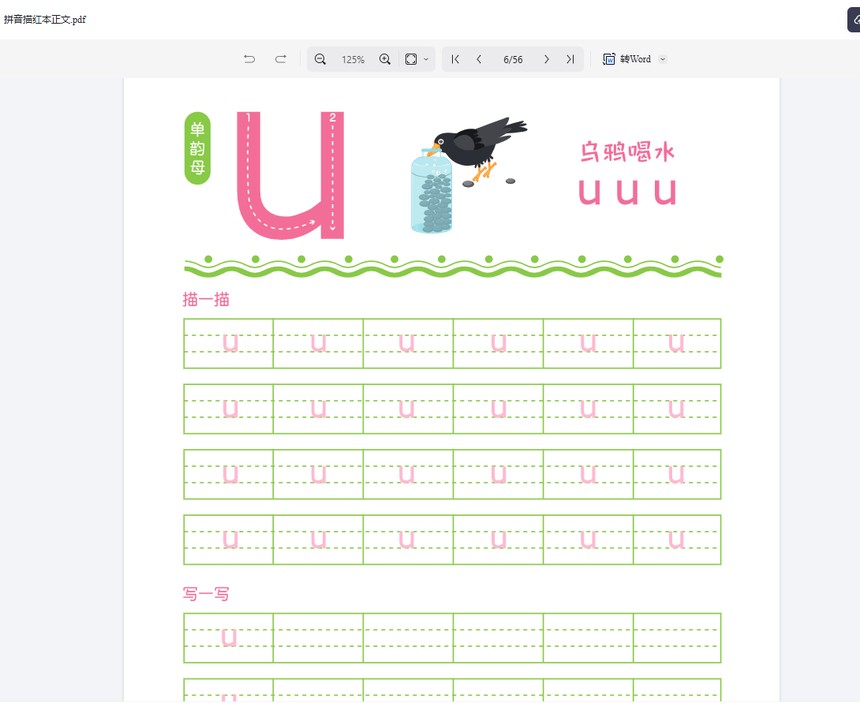
| 3. Single finals (单韵母) | The 6 core vowels: a o e i u ü | Single-final practice; single-final + initial drills |
| 4. Compound & nasal finals | Combined vowels & nasal endings | Compound-final book; front/rear nasal-final books |
| 5. Initials + blending | Consonants & syllable reading | Daily pinyin reading (PEP grade 1); “I want to be a blending pro”; new pinyin reading |
| 6. Tracing & writing | Handwriting the letters | Pinyin tracing book; 29-page bridge-stage tracing copybook |
| 7. Daily drill | Habit & speed | “Pinyin every day”; bridge-stage daily practice; summer daily drills |
| 8. Checkpoints | Mastery checks | Grade-1 categorized pass-tests; “bridge-stage pinyin must-knows (grade-1 exam)”; sound-choice drills |
| 9. Fun & extras | Engagement | Pinyin maze game book; “My First Pinyin Book”; the “ü drops its dots” rule sheet |
That is roughly one video course and 33 printable PDFs in a single share — more than enough for a full school year if used a few pages at a time. The point is not to finish it fast; the point is that every sub-skill has a matching page.
The pinyin alphabet at a glance
If you have never seen the full chart, here it is. This is the entire sound system your child needs to master:
| Group | Sounds | Count |
|---|---|---|
| Initials (声母) | b p m f d t n l g k h j q x zh ch sh r z c s y w | 23 |
| Single finals (单韵母) | a o e i u ü | 6 |
| Compound finals (复韵母) | ai ei ui ao ou iu ie üe er | 9 |
| Front nasal (前鼻韵母) | an en in un ün | 5 |
| Rear nasal (后鼻韵母) | ang eng ing ong | 4 |
| Whole syllables (整体认读) | zhi chi shi ri zi ci si yi wu yu ye yue yuan yin yun ying | 16 |
Print this chart and put it on the fridge. Most “I can't read this character” moments in early grade 1 come down to one missing piece in this table — usually a nasal ending or a tone.
How to use the kit at home (a realistic plan)
You do not need an hour a day. Fifteen minutes, most days, beats a two-hour cram on Saturday. Here is a path that works for out-of-school learners:
- Weeks 1–3 (ages 4–5, or total beginners): Watch one “Pinyin Kingdom” video segment, then sing the matching song. No writing yet — just ears and mouth. Goal: your child can hear and say the 6 single finals and a handful of initials.
- Weeks 4–8: Add the single-final and initial worksheets. Do 2–3 rows per sitting. Introduce tones with hand gestures (flat, up, down-up, down).
- Weeks 9–14: Move to compound and nasal finals. Use the daily-reading PDFs to blend initials + finals into real syllables (ba, ma, ni, hao).
- Weeks 15–20: Start the tracing copybooks. Handwriting cements sound-to-shape. Keep it short — tired hands make messy habits.
- Ongoing: Use the daily-drill and checkpoint PDFs as low-pressure quizzes. The “ü drops its dots” sheet is a classic grade-1 trap — teach it early and revisit it.
If your child is already in grade 1 and struggling, skip to stage 5–8 and use the “must-knows (grade-1 exam)” and categorized pass-tests as targeted catch-up. Those are built exactly for the parts schools move through fastest.
Common mistakes parents make
- Rushing to characters. A child who cannot sound out “h–ao” will memorize 好 as a picture and forget it in a week. Pinyin first pays off for years.
- Ignoring tones. Tones are not decoration — mā, má, mǎ, mà are four different words. Drill them from the start or they are very hard to fix later.
- Too much per day. Ten calm minutes beat a tearful half-hour. Pinyin is repetition, not intensity.
- No chart on the wall. Out of sight, out of mind. The fridge chart is the cheapest, highest-return tool in the kit.
Frequently asked questions
At what age should my child start pinyin?
Around age 4–5 is comfortable for most children, once they can sit for short focused tasks and have some spoken Chinese. Younger children can enjoy the songs and videos without formal drills.
My Mandarin is not great. Can I still teach pinyin?
Yes. Pinyin is spelled with the Roman alphabet and the materials are visual. As long as you can follow the chart and play the audio, you can guide practice. Where your pronunciation is unsure, lean on the video course and song audio.
Do we need the video course, or are the worksheets enough?
Worksheets alone work, but they are dry. The video course turns abstract sounds into a story, which is what keeps a 5-year-old engaged. If you only pick one extra, pick the videos or the songs — engagement is the bottleneck, not content.
How is pinyin different from English phonics?
They share the idea of “letters represent sounds,” but pinyin is a full phonetic map of Mandarin with tones, while English phonics deals with inconsistent spelling-to-sound rules. A child who knows one will find the other easier, but they are not interchangeable.
When can we stop using pinyin?
Natural Chinese readers start dropping pinyin once they recognize a few hundred common characters, usually within the first year of primary school. Keep it available as a crutch, but don't force it once your child reads confidently.
Getting the materials
The starter kit described above — the “Pinyin Kingdom Adventure” video course plus the 33 printable PDFs — is shared as a single collection. The original share link uses a Chinese cloud drive (Quark), which is most convenient for users with a Chinese phone number or app account.
🔗 Resource link (the full collection):
https://pan.quark.cn/s/b35c8c27da84
A quick, honest note for overseas families: this collection is hosted on Quark Drive (夸克网盘), a Chinese cloud service. You can open the link in a browser and browse the file list, but saving or downloading usually requires the Quark app and, in many regions, a mainland-China phone number to sign in. If that is awkward where you are, the teaching plan above still works with any pinyin chart and worksheet set — tell me which channel suits you (Google Drive, email, etc.) and I can point you to the most accessible version.
⚠️ Resource note
The materials referenced here are compiled from publicly shared educational resources and are intended for personal, home study use only. They are not sold here and are not a substitute for official textbooks. Please respect copyright, do not redistribute commercially, and support the original publishers by purchasing authorized editions when available. If any item infringes a right, contact us and it will be removed.
• Free Printable Chinese Flashcards — the full flashcard overview
• Chinese Character Tracing Worksheets — model, trace, then write
• Flashcards with Pinyin and English — characters + tone-marked pinyin + meaning
• Pinyin Worksheets for Kids — printable tracing, tone and blending sheets
• Pinyin Songs for Kids — rhymes and chants that teach tones
• Teach Pinyin at Home (Non-Native Parent) — audio models and a 10-minute routine
• Chinese Pinyin Chart for Kids — printable initials, finals and tones
Disclaimer: The resources mentioned on this page are collected from public channels for personal learning and sharing. All copyrights belong to their original authors or publishers. Please do not use them for commercial purposes, and delete the files within 24 hours of downloading. If any content appears to infringe a copyright, contact us and we will remove it promptly. Whenever possible, please support the original creators by purchasing official versions.